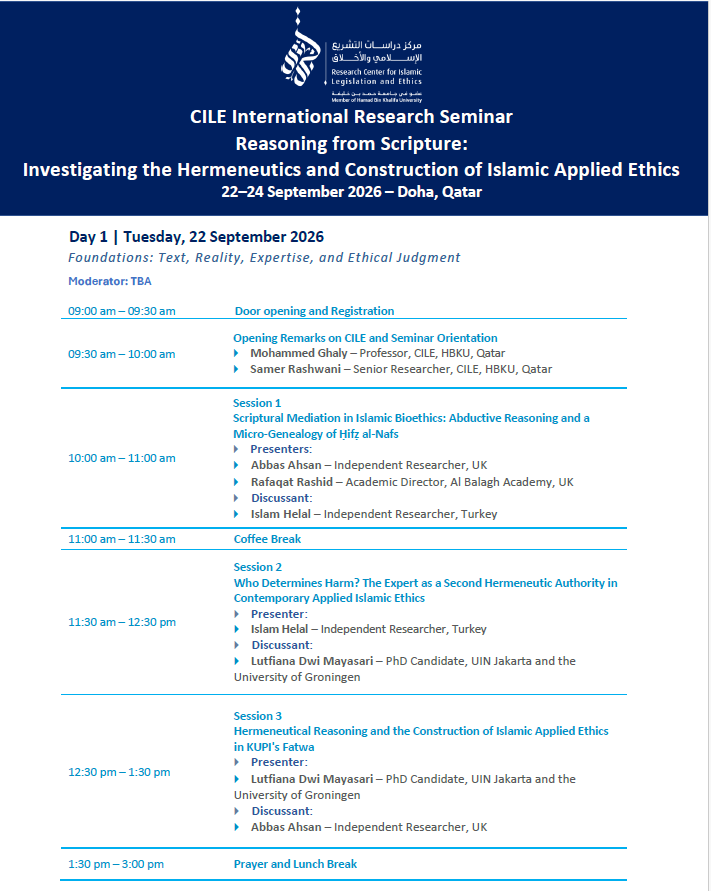
On 22–24 September 2026, the Research Center for Islamic Legislation and Ethics (CILE) at Hamad Bin Khalifa University hosted the international research seminar “Reasoning from Scripture: Investigating the Hermeneutics and Construction of Islamic Applied Ethics” in Doha, Qatar, which was convened by Dr. Samer Rashwani, Senior Researcher and Lecturer in Scriptural Ethics at CILE, HBKU.
The seminar opened with remarks by Dr. Mohammed Ghaly, Professor and Director of CILE, explaining the activities of CILE, including conferences and seminars on interdisciplinary issues related to Islamic ethics and Islamic thought. He stated that the Center offers many opportunities to its internal faculty and external researchers to convene seminars and conferences, aiming to bring together fragmented voices that contribute to discussions rooted in the Islamic tradition engaging with the international discourse. CILE undoubtedly supports continuous academic partnership and exchange with researchers internally and externally, as many of CILE’s activities are held in association with other institutions, research centers, and universities. Researchers could collaborate with CILE through:
● the Visiting Professor program, hosted for one semester, where professors gain research funding, and may also teach a course in the Master of Arts in Applied Islamic Ethics, through Hamad Bin Khalifa University (HBKU),
● the Journal of Islamic Ethics, published by Brill and indexed by Scopus,
● the Studies in Islamic Ethics Series, published by Brill,
● CILE’s international conferences,
● CILE Winter and Summer Schools, etc.
He mentioned the CILE’s successful hosting of 17th World Congress of Bioethics in 2024, and international conference on “AI Ethics: The Convergence of Technology and Diverse Moral Traditions” in 2025. He also introduced CILE’s leading international platforms, the International Islamic Bioethics Association (IIBA) and the Global Alliance for AI Ethics (GAAIE).
Dr Samer Rashwani then offered introductory remarks on the seminar topic. He explained the central question underpinning the three-day discussions: how do Muslim scholars make scriptural sources ethically relevant to contemporary realities? He noted that rapid scientific developments and changing social and political contexts have intensified the need to revisit the Qur’an and Sunnah in search of guidance on contemporary issues. This continuing effort has contributed to the emergence and growth of the field of Islamic Applied Ethics.
He emphasized that the seminar was concerned not only with ethical conclusions or fatwas, but with the hermeneutical processes through which scriptural texts are interpreted and translated into contemporary ethical reasoning. The discussions therefore examined how scholars negotiate the relationship between revelation, interpretive tradition, empirical knowledge, and changing realities.
The programme was organized around three broad thematic areas: “Foundations: Text, Reality, Expertise, and Ethical Judgment”; “Qurʾanic Concepts in Motion: Reciprocity, Vicegerency, Allegiance, and Obedience”; and “Hadith, Ontology, and the Construction of Bioethical and Environmental Norms.”
Day 1 | Tuesday, 22 September 2026
The first day focused on the relationship between scriptural texts, changing realities, expert knowledge, and ethical judgment. The opening session, “Scriptural Mediation in Islamic Bioethics: Abductive Reasoning and a Micro-Genealogy of Ḥifẓ al-Nafs,” presented by Dr. Abbas Ahsan and Dr. Rafaqat Rashid, examined contemporary Islamic bioethics as a process of scriptural mediation governed by uṣūl al-fiqh. Using the concept of ḥifẓ al-nafs as a case study, the discussion traced how scriptural commitments concerning the preservation of life, bodily sanctity, and responsibility for killing were transformed into juristic principles and applied within changing biomedical contexts. Together they explored the role of abductive reasoning and juristic procedures such as taʿlīl, takhrīj al-manāṭ, al-ṣabr wa al-taqsīm, and tarjīḥ in addressing contested biomedical realities.
The second session, “Who Determines Harm? The Expert as a Second Hermeneutic Authority in Contemporary Applied Islamic Ethics,” presented by Dr. Islam Helal, examined the role of biomedical and technical expertise in shaping the very cases upon which juristic judgments are made. He proposed the concept of a “Second Hermeneutic Authority” to describe the growing role of expert institutions in defining technical thresholds of harm before a jurist begins the process of deriving a ruling. Drawing on examples including brain death, preimplantation genetic diagnosis, and prospective triage algorithms, he raised questions about the relationship between juristic authority and the technical construction of contemporary realities. He also proposed developing Fiqh academies to cultivate the "Cross-Disciplinary Jurist."
The third session, “Hermeneutical Reasoning and the Construction of Islamic Applied Ethics in KUPI's Fatwa,” presented by Lutfiana Dwi Mayasari, turned to contemporary fatwa-making in Indonesia. Focusing on KUPI’s 2022 fatwa concerning the protection of women from female genital cutting and mutilation, the paper examined how scriptural authority is reconstructed through the integration of Qurʾanic and hadith interpretation, taḥqīq al-manāṭ, medical expertise, and maqāṣid al-sharīʿah. She highlighted the role of epistemic partnership between revelation, empirical knowledge, and ethical deliberation in the formation of contemporary applied Islamic ethics.
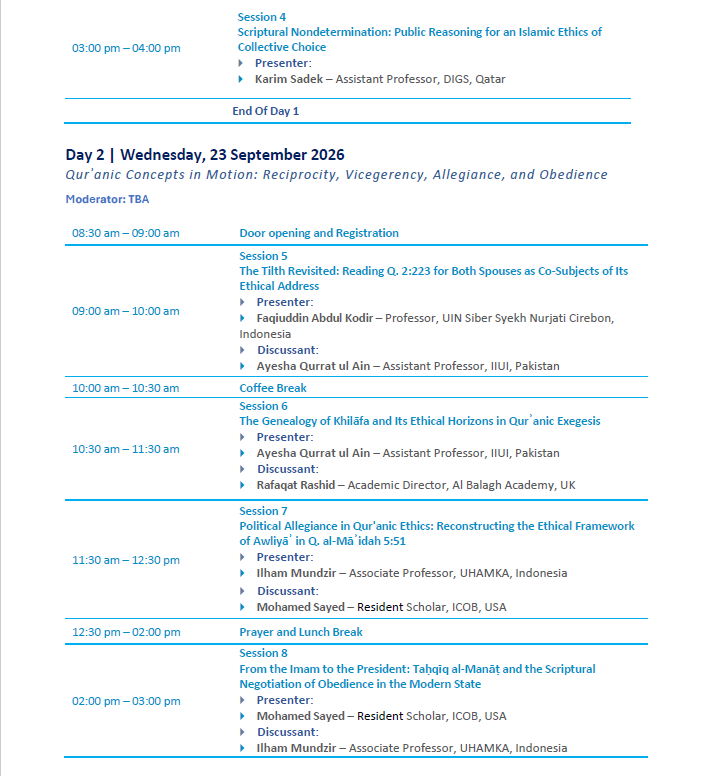
The final session of the day, “Scriptural Nondetermination: Public Reasoning for an Islamic Ethics of Collective Choice,” presented by Dr. Karim Sadek, addressed the relationship between scriptural authority and collective decision-making. The paper proposed a two-step normative architecture in which scholarly interpretation identifies alternatives that are compatible with scripture, while public reasoning contributes to selecting among those alternatives. This framework distinguished between hermeneutical authority and practical authority and explored how scriptural authority might be maintained without extending it into exclusive authority over collective choices.
Day 2 | Wednesday, 23 September 2026
The fifth session, “The Tilth Revisited: Reading Q. 2:223 for Both Spouses as Co-Subjects of Its Ethical Address,” presented by Dr. Faqiuddin Abdul Kodir, reconsidered the interpretation of Qurʾan 2:223 in relation to marital ethics. Drawing on classical principles of Qurʾanic interpretation, including taʾmīm al-khiṭāb and munāsabat al-āyāt, the paper argued that the verse can be read as addressing both spouses rather than treating women solely as objects of the verse’s ethical address. The author further employed Qirāʾah Mubādalah (Reciprocal Reading) to develop an interpretation centered on reciprocity and mutuality in marital relations.
The sixth session, “The Genealogy of Khilāfa and Its Ethical Horizons in Qurʾanic Exegesis,” presented by Dr. Ayesha Qurrat ul Ain, examined the Qurʾanic concept of khilāfa through a comparative reading of the exegetical tradition. The paper considered interpretations of Q. 2:30 by al-Ṭabarī, Fakhr al-Dīn al-Rāzī, Maḥmūd al-Ālūsī, and Fazlur Rahman, examining how different understandings of humanity and the cosmos shaped the ethical responsibilities associated with human vicegerency. The study highlighted the relationship between ontology and ethics and considered how changing conceptions of the human condition influence interpretations of human responsibility toward the natural world.
The following session, “Political Allegiance in Qur'anic Ethics: Reconstructing the Ethical Framework of Awliyāʾ in Q. al-Māʾidah 5:51,” presented by Dr. Ilham Mundzir, examined the Qurʾanic concept of awliyāʾ and its implications for political allegiance. The paper explored the semantic dimensions of the term and its interpretation in relation to broader Qurʾanic ethical values, seeking to reconstruct a framework for understanding political allegiance beyond a simple binary between religious exclusivism and liberal constitutionalism. The author argued that the central criterion for political legitimacy should not be the religious identity of political actors, but their alignment with higher Qurʾanic ethical values, including justice, trustworthiness, human dignity, and public welfare.
The eighth session, “From the Imam to the President: Taḥqīq al-Manāṭ and the Scriptural Negotiation of Obedience in the Modern State,” presented by Dr. Mohamed Sayed, focused on the application of classical jurisprudential reasoning to contemporary political authority. Using Qurʾan 4:59 and the concept of taḥqīq al-manāṭ, the paper examined the methodological question of whether a ruling developed in relation to a particular form of political authority can be transferred directly to the modern nation-state. The presentation emphasized the importance of identifying the actual locus and conditions to which the ruling applies when moving from inherited texts and precedents to new political contexts.
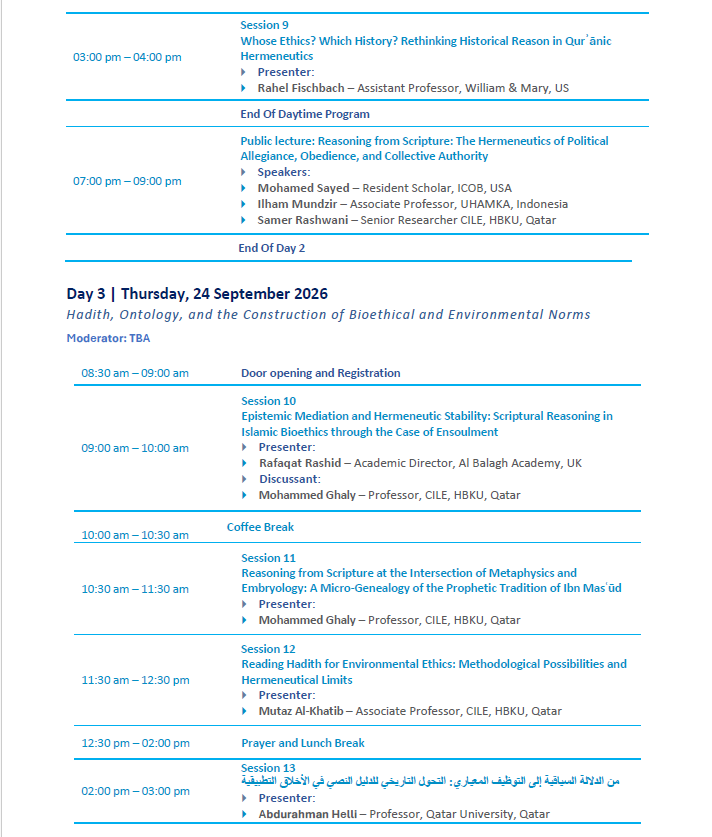
The ninth session, “Whose Ethics? Which History? Rethinking Historical Reason in Qurʾānic Hermeneutics,” presented by Dr. Rahel Fischbach examined historical contextualization as a methodological approach in contemporary Qurʾanic ethics and questioned the assumptions about temporality, human agency, revelation, and scriptural authority embedded within different approaches to history. It considered how historical reasoning can open new interpretive possibilities while simultaneously establishing particular assumptions about how scripture, history, and moral reasoning relate to one another.
The day concluded with a public lecture titled “Islamic Scripture, Politics, and the Modern State,” in which Dr. Mohamed Sayed, Dr. Ilham Mundzir, and Dr. Samer Rashwani explored different aspects of the topic.
Day 3 | Thursday, 24 September 2026
The third day began with “Epistemic Mediation and Hermeneutic Stability: Scriptural Reasoning in Islamic Bioethics through the Case of Ensoulment,” presented by Dr. Rafaqat Rashid. Focusing on the Prophetic tradition concerning embryological development and ensoulment, the paper distinguished between metaphysically authoritative claims, empirically revisable descriptions, hermeneutic judgments, and legal applications. The paper examined how changes in scientific knowledge may affect the factual application of inherited indicators without automatically determining a change in their legal significance, highlighting the role of juristic reasoning in mediating between scientific developments and inherited legal frameworks.
The next session, “Reasoning from Scripture at the Intersection of Metaphysics and Embryology: A Micro-Genealogy of the Prophetic Tradition of Ibn Masʿūd,” presented by Dr. Mohammed Ghaly, further explored the relationship between revelation, metaphysics, empirical knowledge, and embryology. The paper traced the reception of the Ibn Masʿūd tradition through pre-modern theological and juristic deliberations and examined the transformations introduced by modern embryology, fetal ultrasonography, and assisted conception. The paper argued that scriptural reasoning remains the indispensable anchor of Islamic applied ethics across historical epochs, while the integration of extra-scriptural empirical knowledge is shaped not by technological developments alone, but also by changing socio-political, institutional, and linguistic conditions. Author also discussed the changing epistemic relationship between religious scholars and biomedical specialists and to the ways institutional and linguistic transformations have affected contemporary processes of collective ijtihād.
The twelfth session, “Min al-naṣṣ ilā al-qīma: Arbaʿūna ḥadīthan fī akhlāqiyyāt al-bīʾa,” presented by Dr. Mutaz Al-Khatib, explored the use of Prophetic traditions in constructing an Islamic environmental ethics. The paper examined forty hadiths and identified central ethical values within the selected traditions, considering how these values may contribute to contemporary environmental ethics. The discussion addressed themes including the value and place of nature, human responsibilities toward nature and the limits of human intervention, and environmental justice. It also raised methodological questions about how textual evidence may move from certain narrations toward broader normative principles.
The final research session, “Min al-dalāla al-siyāqiyya ilā al-tawẓīf al-miʿyāriyy: al-taḥawwul al-tārīkhiyy li-al-dalīl al-naṣṣiyy fī al-akhlāq al-taṭbīqiyya,” presented by Dr. Abdurahman Helli examined the historical transformation of scriptural evidence from contextual meaning into normative application in contemporary applied ethics. Drawing on examples from contemporary biomedical and cosmetic practices, the paper explored how Qurʾanic expressions may be interpreted beyond their immediate textual contexts and developed into broader grounds for ethical reasoning. It also considered the role of exegetes, jurists, and hadith scholars in shaping these processes and the methodological questions involved in moving from textual evidences toward broader normative applications.
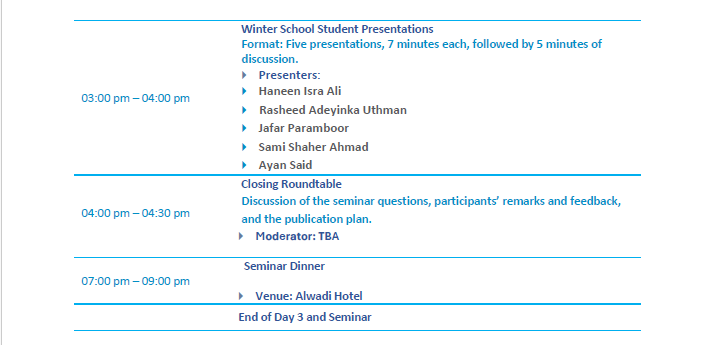
The academic programme concluded with presentations by four Winter School students—Haneen Isra Ali, Rasheed Adeyinka Uthman, Sami Shaher Ahmad, and Ayan Said. Each presentation was followed by discussion, providing the students with an opportunity to engage with the seminar’s broader methodological concerns.
The seminar concluded with a closing roundtable addressing the central seminar questions, participants’ remarks and feedback, and the publication plan.